
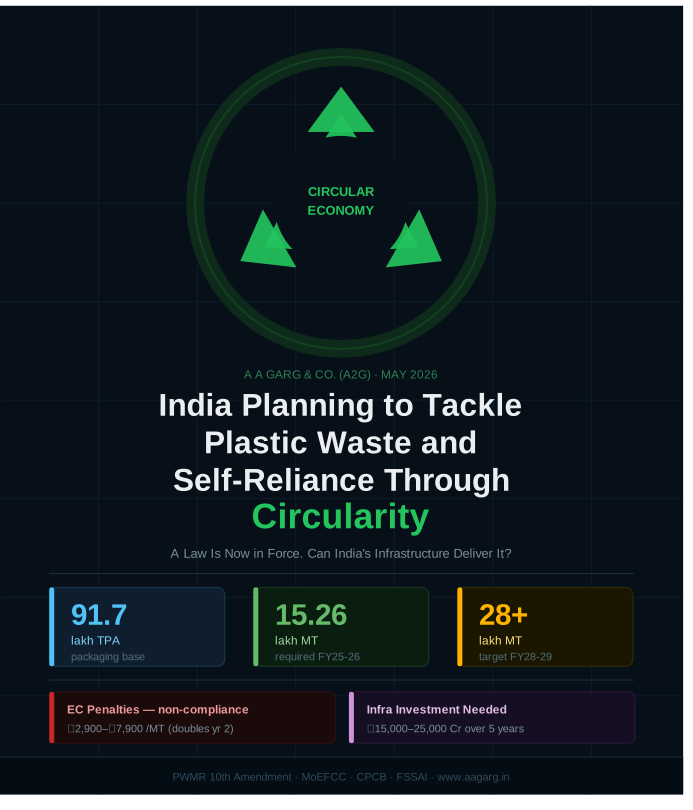
On 31st March 2026, MoEFCC published the 10th Amendment to India’s Plastic Waste Management Rules — making it legally mandatory for every producer, importer, and brand owner selling a product in plastic packaging to incorporate a minimum percentage of recycled plastic. This obligation (the Use of Recycled Plastic mandate — UReP) is in force from 1 April 2025, with targets escalating annually through FY 2028-29 and financial penalties for every tonne of shortfall.
- Abhishek Garg, Founder & CEO, A A Garg & Co.
- Ipsita Roy, AVP, A A Garg & Co.
THE MANDATE — WHAT INDIA HAS REQUIRED
Non-compliance attracts Environmental Compensation (EC) penalties: ₹2,900/MT for rigid packaging, ₹5,000/MT for flexible packaging, and ₹7,900/MT for multi-layer packaging — doubling in year 2 of default and tripling in year 3.
91.7 L TPA
Total plastic packaging base
~15.26 L MT
Recycled content required — FY 2025-26
~28+ L MT
Projected annual requirement by FY 2028-29
| Category | Packaging Type | FY25-26 | FY26-27 | FY27-28 | FY28-29 | Demand FY25-26 |
|---|---|---|---|---|---|---|
| Cat I – Rigid | Bottles, jars, rigid containers | 30% | 40% | 50% | 60% | ~9.72 L MT |
| Cat II – Flexible | Wrappers, pouches, sachets, dairy packs | 10% | 10% | 20% | 20% | ~5.14 L MT |
| Cat III – MLP* | Juice cartons, tetra-type packs | 5% | 5% | 10% | 10% | ~0.40 L MT |
| TOTAL | India’s full packaging base | – | – | – | – | ~15.26 L MT |
*Cat III: the 5% target applies only to plastic-layer weight within the multi-layer structure — not the total gross weight of the package. A standard aseptic carton is ~70% paperboard and only ~18–23% plastic, making the effective obligation significantly smaller than the headline percentage suggests.
THE INFRASTRUCTURE — WHAT EXISTS TODAY AND WHERE THE GAPS ARE
Category I — Rigid Packaging (bottles, jars, containers): ~32.4 lakh TPA base, 30% target = ~9.72 lakh MT required.
SUPPLY GAP — FOOD-GRADE rPET: 17 FSSAI-authorized plants | Capacity: ~3–3.56 lakh MT/year | Food-grade beverage demand: ~7 lakh MT | Shortfall: ~4–6 lakh MT | Source: APR Bharat, March 2026; A2G White Paper 2026
Category II — Flexible Packaging (wrappers, pouches, sachets, dairy packs): ~51.4 lakh TPA — India's largest packaging category. 10% target = ~5.14 lakh MT required.
| Challenge | What It Means in Practice |
|---|---|
| No FSSAI approval for recycled PP or PE | Unlike PET, there is no authorized process, no approved recycler list, and no regulatory pathway for food-grade recycled PP or PE. Most FMCG flexible food-contact packaging has zero compliant recycled content option in India today. |
| Multi-layer laminates cannot be mechanically recycled | Chip packets, pouches, and dairy packs combine BOPP, LDPE, PET film, and aluminium foil bonded with adhesives. These layers cannot be meaningfully separated — the entire packet becomes low-grade mixed plastic waste. |
| Chemical recycling: the viable long-term pathway – 3–5 years away | Pyrolysis and depolymerization can handle flexible waste and produce food-grade output. Formally recognized under the 10th Amendment — but CPCB has not published a registration framework, so brands cannot yet claim it toward UReP targets. |
KEY IMPLICATION: For most food-contact flexible packaging — dairy pouches, food sachets, FMCG wrappers — no compliant recycled content option exists in India today. Portfolio audit and statutory exemption documentation are the critical near-term actions for brands.
Category III — Multi-Layer Packaging (juice cartons, tetra-type packs): ~7.9 lakh TPA. 5% target (plastic layer only) = ~0.40 lakh MT required.
The Aggregate Picture — Mandate vs. Available Infrastructure
| Category | Category Required FY25-26 Available Today Gap | Available Today | Gap |
|---|---|---|---|
| Cat I – Rigid | ~9.72 lakh MT | ~3–3.56 lakh MT food-grade rPET (FSSAI-authorized); industrial grade for non-food | ~6 lakh MT gap for food-grade; HDPE/PP food-contact has no approved pathway |
| Cat II – Flexible | ~5.14 lakh MT | Near-zero for food-contact; industrial-grade recycled PE/PP for non-food only | Structurally unresolved for food-contact; no FSSAI-approved recycled PP/PE pathway |
| Cat III – MLP | ~0.40 lakh MT (plastic layer) | Very limited; chemical recycling nascent and not portal-registered | Modest but gap persists |
| TOTAL | ~15.26 lakh MT | Significantly below aggregate demand | Large structural gap across all categories |
CLOSING THE GAP — INVESTMENT AND REGULATORY ACTIONS REQUIRED
| Investment Area | What Is Needed | Indicative Requirement |
|---|---|---|
| Food-grade rPET plant expansion | Scale from 17 plants (~3.56 lakh MT/year) to 50+ plants (~15 lakh MT/year) by FY 2028-29; super-clean decontamination technology required. | INR 8,000–12,000 Cr |
| Chemical recycling Feedstock infrastructure | Pyrolysis and depolymerization plants for flexible and MLP waste — the only pathway to food-grade recycled PE/PP. | INR 4,000–6,000 Cr |
| Post-consumer collection & traceability | Formalization of 2M+ waste collectors; post-consumer waste segregation; chain-of-custody digital infrastructure. | INR 2,000–4,000 Cr |
| TOTAL | 5-year investment to achieve FY 2028-29 target infrastructure at scale | INR 15,000–25,000 Cr |
| # | Action Required | Why It Is Critical | Priority |
|---|---|---|---|
| 1 | FSSAI must publish food-grade guidelines for recycled PE and PP | 10% flexible packaging target is structurally unachievable for food-contact without this. Also unblocks Cat I HDPE/PP food-contact recycling. Single action that unlocks private rPE and rPP investment overnight. | CRITICAL – FY 2025-26 |
| 2 | CPCB must publish a registration framework for chemical recyclers | Chemical recycling is recognized under the 10th Amendment — but without a portal registration mechanism, brands cannot claim it toward UReP targets. | HIGH – FY 2025-26 |
| 3 | MoEFCC must distinguish Post-Consumer from Post-Industrial Waste | Current rules count manufacturing scrap as equivalent to genuinely recycled post-consumer plastic — a fundamental integrity gap that undermines India’s circular economy credentials internationally. | HIGH – FY 2025-26 |
The mandate is historic. The gap is real. The opportunity is enormous.
India’s ambition on circularity and self-reliance through recycled material use is real. The infrastructure challenge is the critical path. The regulatory and capital response will define whether this mandate transforms India’s packaging economy — or remains a target on paper.
About the Authors: Abhishek Garg is the Chartered Accountant from 2017 batch and is currently operating as Founder & CEO of A A Garg & Co. and Ipsita Roy, MBA and postgraduate in Env. Sc. Is currently serving as the AVP of A A Garg & Co. (A2G) which is recognized as India’s specialist EPR & Circularity assurance and advisory practice — advising 75+ Fortune 500 companies and 400+ PIBOs.
Data Sources: CPCB Registered PIBO Disclosures FY24-25; A2G UReP & Reuse White Paper 2026; FSSAI FSS (Packaging) First Amendment Regulations 2025; WIREs Energy & Environment — Hossain et al., 2024; BIS IS 14534:2023; PWMR 10th Amendment, 31 March 2026. Figures are indicative. This article is for industry discussion and does not constitute legal or compliance advice.